English
Kicker Candlestick Pattern: What It Means, With a Real NOW Example
Published · Candle patterns
A kicker is two candles of opposite colours separated by a gap. The first session ends one way; the next session opens beyond where the first one even started, in the opposite direction, and never looks back. It is the market changing its mind overnight — and it is one of the strongest reversal shapes in the candlestick list, because the gap means the move happened while nobody could trade it.
Most patterns form gradually, candle by candle. A kicker is abrupt: whatever the first candle said, the second candle says the opposite, louder, and from a price the first candle never reached.
How to spot a kicker
Look at two consecutive daily candles of opposite colours, with a gap between them. The rule for the gap is specific: the second candle's open must be beyond the first candle's open, on the opposite side.
- Bullish kicker. The first candle is down. The second candle opens above the first candle's open — a gap up beyond where the decline even started — and closes up. The market fell, then opened higher than the fall's starting point and kept going.
- Bearish kicker. The first candle is up. The second candle opens below the first candle's open — a gap down beyond where the rise even started — and closes down. The market rose, then opened lower than the rise's starting point and kept falling.
The gap is the whole pattern. Without it, two opposite candles are just a reversal day. With it, the second candle starts from a price the first candle's traders never saw, which means the sentiment shift happened between sessions — usually on news, or on a reassessment that arrived overnight.
What a kicker may mean — and what it cannot
A kicker matters most when it reverses a real move. A bearish kicker after a rise says the buyers who controlled the first session were overwhelmed before the second session even opened — the sellers did not need the session to turn the price; they had already turned it at the open. A bullish kicker after a fall says the same thing in reverse. Because the gap skips over the prices in between, there is no orderly handover: it is a clean break.
That strength is also the pattern's weakness as a signal. A gap can fill. The second candle can close back inside the first candle's range the following session, and the "reversal" becomes a one-day gap that meant nothing. A kicker needs the next candles to stay on its side of the gap — a close back through the gap is the pattern failing in front of you.
A kicker also cannot tell you why the gap happened, or how far the new move goes. It describes two sessions and the space between them. Treat it as a prompt to look at what changed overnight, not as a trade call on its own.
A real example: a bearish kicker on ServiceNow (NOW), November 13–16, 2026
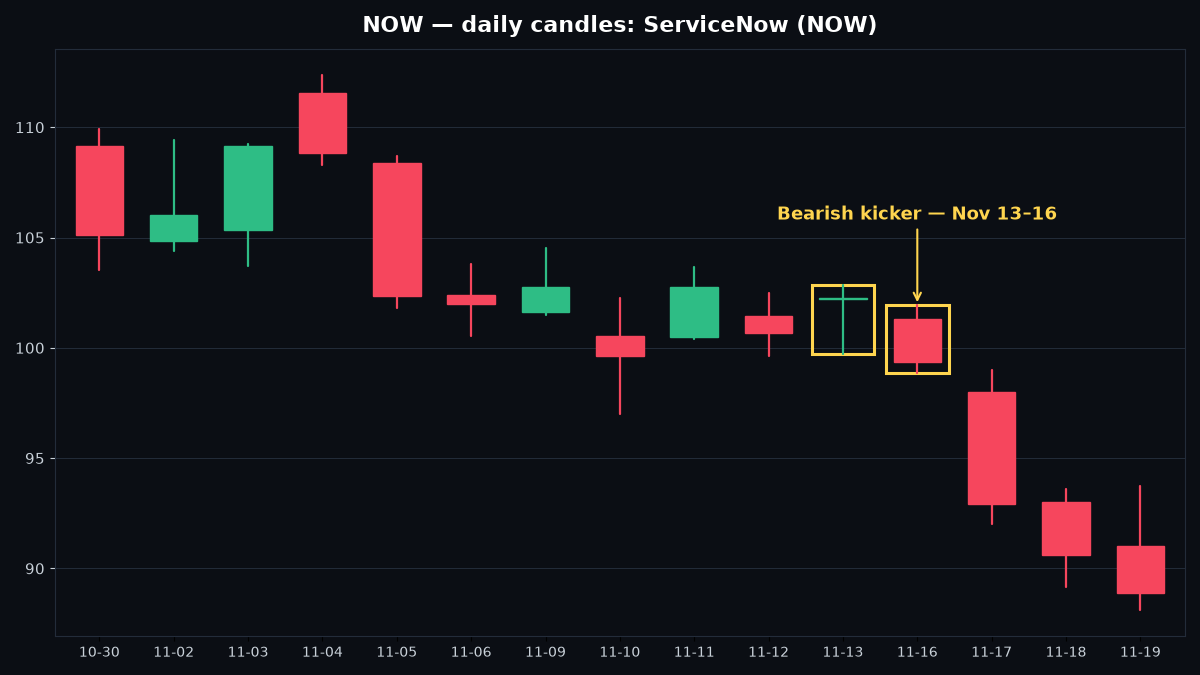
ServiceNow (NOW) printed a clean bearish kicker on November 13–16, 2026 — a Friday, then the following Monday. The numbers:
- November 13: open $102.20, high $102.86, low $99.70, close $102.25
- November 16: open $101.30, high $101.94, low $98.88, close $99.37
The first candle is an up candle that finished near its high — though its body is only $0.05, so Friday was really a flat session rather than a strong rise. The kicker rule only needs the gap, and the gap is genuine: the second candle opened at $101.30 — below the first candle's open of $102.20 — and closed at $99.37, down on the day. The market opened Monday below where Friday's drift had even started, and sold off from there.
The follow-through was decisive. NOW closed at $92.90 on November 17, down 6.5% from the kicker, at $90.59 on November 18, down 8.8%, and at $88.87 on November 19, down 10.6%. The kicker marked the point where a stock that had been drifting sideways gave way and fell for four straight sessions.
For the other form, Caterpillar (CAT) printed a bullish kicker on November 6–9. The first candle is a big down candle: open $571.82, high $572.00, low $554.61, close $558.63. The second candle opened at $573.99 — above the first candle's open of $571.82 — with a high of $599.78 and a low of $572.05, and ran to a close of $598.88, a body covering 90% of its range. The gap up beyond the prior open is the kicker in reverse. But the follow-through was flat: CAT closed at $584.57 on November 10, down 2.4%, at $601.61 on November 11, and at $605.28 on November 12. The gap marked the low, but the rally did not run — a reminder that a kicker marks a turn, not a trend.
Reading a kicker with the levels
A kicker is only worth attention next to a level, so check the levels first. On NOW's page, the nearest support sits at the volume area low of $86.99, with heavy overhead supply from the fair value gap zones starting at $93.49. The kicker printed on November 16 with the close at $99.37 — already inside that overhead supply — and the four sessions that followed carried the stock down to $88.87 by November 19, and to $87.65 by November 20, just above the $86.99 support. The kicker pointed at the level; the stock went and tested it.
The questions to ask of any kicker: was the first candle a real move, or an ordinary session? Did the second candle genuinely gap beyond the first candle's open — not just beyond its close? Where did the pair print — after a long move, at a level, or in the middle of nowhere? And did the following sessions stay on the kicker's side of the gap, or close back through it? If the answers are "real move," "genuine gap," "at a level" and "the gap held," the kicker earned its attention. If price closes back through the gap, the pattern has failed.
Keep learning
For the full overview of every pattern — one, two and three candles — and how to read the pattern note on a ticker page, see the candlestick-patterns guide: https://tickerlevels.com/learn/candlestick-patterns
You can also read ServiceNow's live page, with its current levels and latest pattern note, at https://tickerlevels.com/ticker/NOW
Educational only — not financial advice.
Tickers in this guide
Sources
Educational technical analysis. Not financial advice. Market data may be delayed or incomplete.