English
SpaceX gets FCC green light for 1 million orbital AI satellites as the stock bounces back to $127
Published · Ticker SPCX
SpaceX got a real green light on Wednesday. The Federal Communications Commission approved the company's plan to deploy up to 1 million satellites designed to process artificial intelligence workloads in orbit — the Starmind network. The authorization lets SpaceX start deploying by November 2033, with milestones of 100,000 satellites by November 2035 and 500,000 by November 2038. The satellites would run on solar power in orbit and route data back to Earth through laser links connected to Starlink. For SpaceX, it opens a second business on top of the broadband one: selling computing capacity in space, not just connectivity.
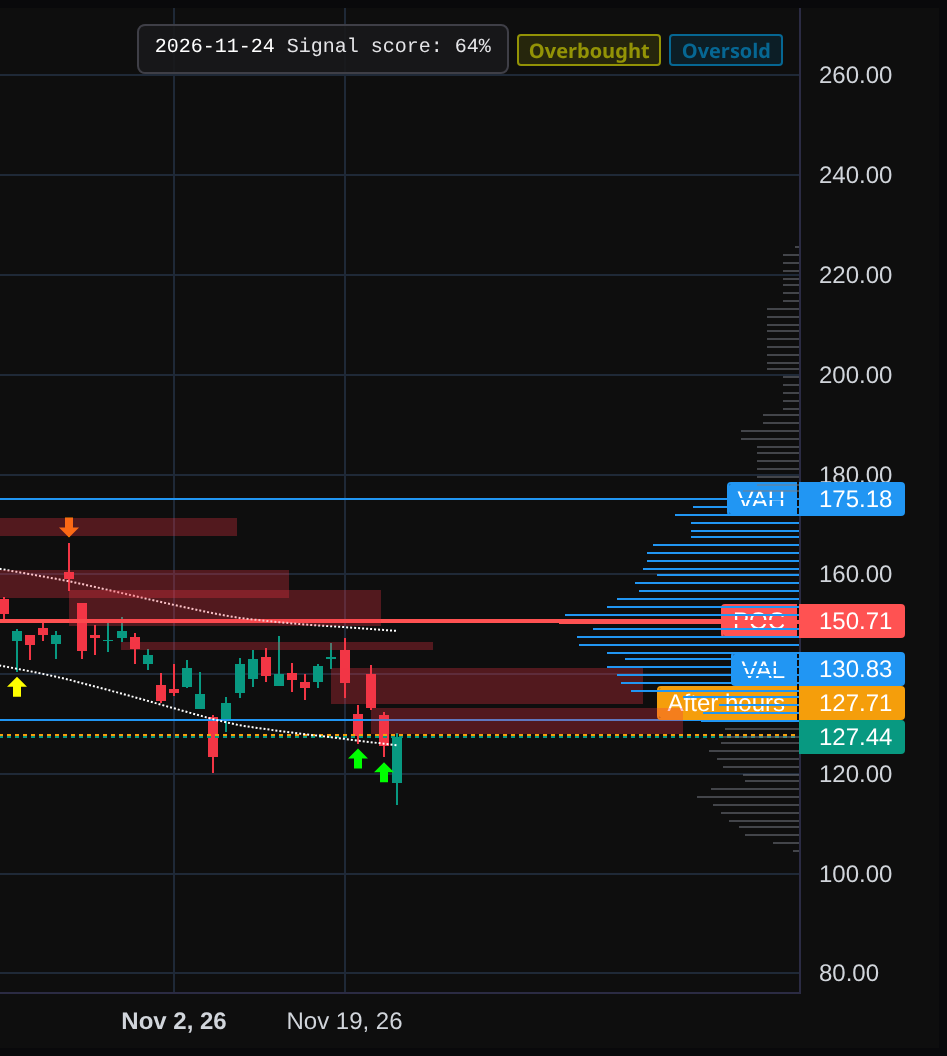
The approval landed on a wild day for the stock. SpaceX sank as much as 9.4% intraday after the cost of insuring its debt — five-year credit default swap spreads — hit record highs for a second straight session, and with free cash flow running at a $35 billion shortfall through the first nine months of 2026, the market is openly worried about how the AI buildout gets financed. But the stock clawed almost all of it back and closed at $127.44, up 1.3%, helped in part by excitement around the orbital-compute story and the possible Tesla merger.
The read from tickerlevels.com is still bearish. SpaceX closed Wednesday at $127.44, up 1.30%, back above its nearest support at $125.74 after dipping to $113.93 intraday. Resistance sits at $133.10, then $136.47 and $141.22. The deciding level is $125.74 — the stock reclaimed it into the close, and holding above it keeps the bounce alive. Lose it, and the $113.93 low is back in play. The merger overhang has not gone away either: Gary Black's $100 buy line rests on the dilution math of an all-stock Tesla deal, with a 25% premium implying roughly 52% more shares.
There is a bullish counterweight. Mizuho initiated coverage this week with an Outperform rating and a $205 price target, and Jefferies has a Buy at $210 — the street consensus sits near $257, roughly double the current price. The argument is vertical integration: SpaceX builds the rockets and the satellites, launches them, and runs Starlink, so it can earn from the processing and from the network that delivers the results. The catch is timing. The FCC approval is long-dated — first deployments are not until 2033 — so it does not answer the financing question the credit market is asking right now. Until the CDS spreads calm down, the tape stays fragile, and $125.74 is the line to watch.
More articles
- SpaceX climbs toward its IPO price as Musk pledges a share a year to every American child Nov 27, 2026
- SpaceX to give one share to every Trump Account — and Musk will match it Nov 25, 2026
- SpaceX credit swaps hit a record as the stock dips 9% - then bounces back to $127 Nov 25, 2026
- SpaceX slides again as Gary Black eyes $100 — merger dilution fear vs S&P fast-track hope Nov 25, 2026
- SpaceX slides 6% as merger talks heat up — J.P. Morgan says a Tesla deal could open the S&P 500 door Nov 24, 2026
See SPCX's latest support and resistance levels →
More SPCX articles → All articles
Sources
Educational technical analysis. Not financial advice. Market data may be delayed or incomplete.